
Ask any home care agency owner or administrator what keeps them up at night, and you’ll hear the usual answers—staffing, scheduling, client satisfaction.
But there’s another issue quietly causing just as many problems:
Staff compliance.
Not because agencies don’t care about it—but because keeping up with it is harder than it should be.
The Reality: Compliance Is Constant—and Easy to Fall Behind On
In home care and home health, compliance isn’t a one-time task. It’s ongoing, moving, and constantly changing.
Every caregiver has multiple requirements:
- Certifications that expire
- Documents that need renewal
- Trainings that must be completed
- Items waiting for review or approval
Now multiply that across dozens—or hundreds—of caregivers.
It’s not surprising that things slip through the cracks.
And when they do, the impact is rarely small.
The Problem Isn’t Awareness—It’s Control
Most agencies already know compliance matters. That’s not the issue.
The real challenge is staying in control of it.
Without a clear, centralized system, compliance becomes:
- A spreadsheet that’s always slightly outdated
- A folder system that requires digging
- A constant cycle of emails, texts, and follow-ups
- A last-minute scramble before audits or shifts
You don’t realize how much time it’s taking—until you add it up.
And more importantly, you don’t always see the risk until it’s already a problem.
What Happens When Compliance Is Reactive
When compliance is managed reactively instead of proactively, agencies tend to run into the same patterns:
Last-Minute Surprises
A caregiver is scheduled—then suddenly can’t work because something expired.
Constant Chasing
Office staff spend hours reminding caregivers to upload documents.
Audit Stress
Preparing for audits becomes a scramble instead of a routine check.
Operational Friction
Small compliance gaps turn into scheduling issues, delays, and frustration.
None of this improves care—and all of it drains time.
What Strong Compliance Actually Looks Like
The agencies that run smoother don’t necessarily have fewer requirements—they just manage them differently.
They’ve made compliance:
- Visible – They can instantly see what’s missing, expiring, or pending
- Proactive – They address issues before they become urgent
- Automated – They don’t rely on manual reminders
- Distributed – Caregivers take part in maintaining their own compliance
In other words, compliance isn’t something they chase—it’s something they monitor and guide.
Visibility Changes Everything
One of the biggest shifts agencies can make is moving from “searching for answers” to “seeing them instantly.”
Instead of asking:
- Who is missing documents?
- What’s about to expire?
- What still needs approval?
They already know.
That’s where having a centralized compliance view becomes powerful.
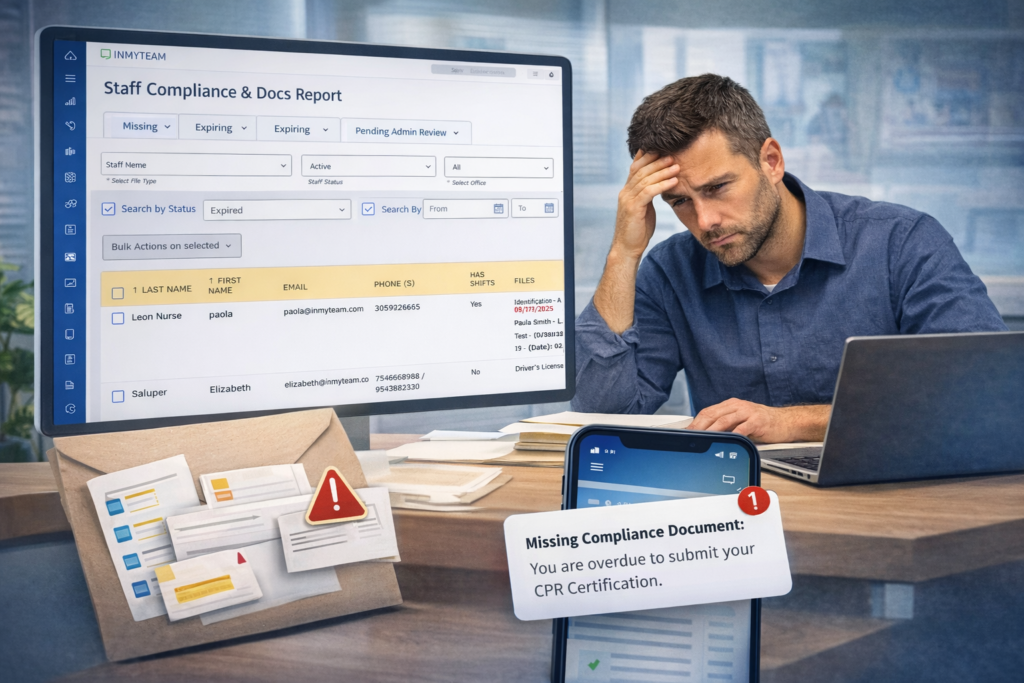
For example, tools like INMYTEAM Home Care Software provide a staff compliance and documents report that organizes everything in one place—showing:
- Missing documents
- Expiring and soon-to-expire items
- Documents pending admin review
- A full compliance snapshot per caregiver
No digging. No guessing. No surprises.
Just clarity.
Automation Is What Keeps It From Falling Apart
Even with visibility, compliance can break down if it depends on people remembering to follow up.
That’s why automation is the second piece most agencies are missing.
When caregivers receive automatic daily reminders about:
- Missing documents
- Expiring certifications
- Upcoming deadlines
Something important happens:
Responsibility shifts.
Instead of compliance living entirely on the admin team, caregivers become active participants in keeping themselves up to date.
And that’s when things start to scale.
Compliance Isn’t Just a Requirement—It’s an Operational Advantage
When compliance is handled well, agencies don’t just avoid problems—they run better.
You start to see:
- Fewer last-minute scheduling disruptions
- Less back-and-forth with staff
- Faster audit preparation
- More confident decision-making
- Stronger trust with clients and partners
It becomes one less fire to put out—and one more system that supports growth.
The Bigger Shift: From Managing Compliance to Controlling It
The agencies that struggle with compliance aren’t doing anything wrong—they’re just relying on systems that weren’t built for how fast things move today.
The ones that succeed have made a shift:
From:
- Reactive → Proactive
- Manual → Automated
- Scattered → Centralized
And most importantly:
From uncertainty → control
Final Thought
Compliance in home care will never be simple—but it doesn’t have to be chaotic.
When you have clear visibility into your staff’s status and systems that keep everything moving automatically, compliance stops being a daily stress point—and starts becoming a strength.
And in an industry where consistency, reliability, and trust matter so much, that shift makes all the difference.