

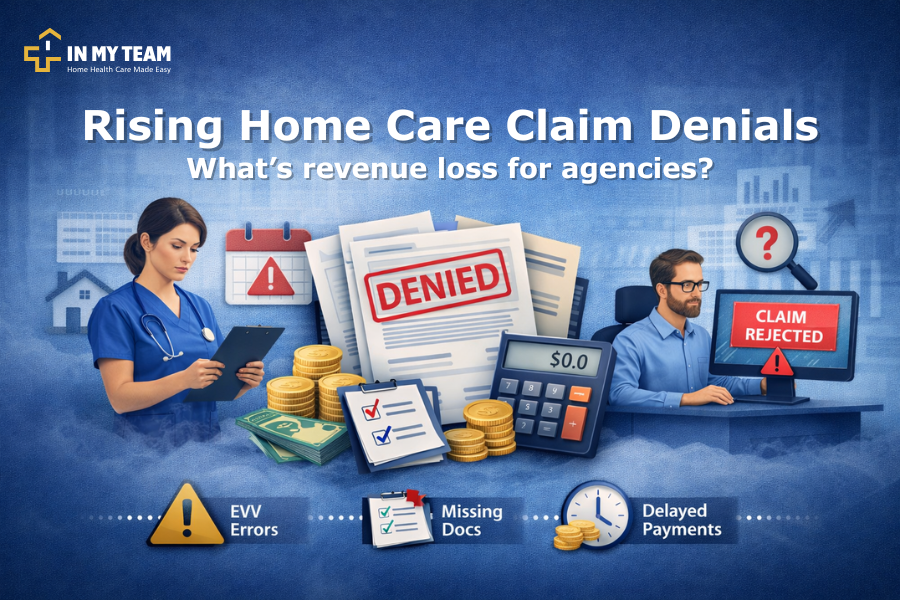
Claim denials in home care are increasing due to stricter payer requirements, documentation errors, and lack of real-time operational visibility. Many agencies focus on fixing denied claims, but the real issue starts earlier — during care delivery and documentation.
What Is Causing the Increase in Home Care Claim Denials?
Claim denials in home care are rising across Medicaid, managed care organizations (MCOs), and private payers. While regulations play a role, most denials stem from operational breakdowns inside the agency.
Common causes include:
- Incomplete or missing caregiver documentation
- EVV (Electronic Visit Verification) discrepancies
- Incorrect service codes or authorization mismatches
- Timing inconsistencies between visits and records
- Failure to meet payer-specific compliance requirements
These issues often go unnoticed until the claim is already submitted — and denied.
Why Claim Denials Are No Longer Just a Billing Issue
Many agencies treat claim denials as a billing problem, but that approach misses the bigger picture.
By the time a claim reaches billing:
- The visit has already happened
- Documentation is already finalized (or incomplete)
- Errors are harder to fix
This means billing teams are left reacting instead of preventing.
👉 The root cause of most home care billing denials starts in operations, not billing.
The Hidden Cost of Denied Claims in Home Care
Denied claims don’t just delay revenue — they create compounding operational costs.
Each denial leads to:
- Time spent identifying the issue
- Administrative rework and corrections
- Resubmission delays
- Follow-up with payers
Over time, this results in:
- Slower cash flow
- Increased administrative burden
- Lost revenue from unresolvable claims
For growing agencies, this becomes a scalability problem.
How Payer Requirements Are Changing in 2026
Home care reimbursement is becoming more complex.
Payers are:
- Increasing documentation scrutiny
- Cross-checking EVV and visit data more strictly
- Tightening compliance requirements
- Reducing tolerance for errors
What was acceptable in previous years is now leading to denials.
Agencies that rely on outdated workflows are seeing denial rates rise — even without changing anything internally.
The Real Problem: Lack of Visibility Into At-Risk Claims
One of the biggest challenges in reducing claim denials is lack of visibility.
Most agencies cannot easily answer:
- Which visits are likely to be denied before submission?
- What are the most common denial reasons across payers?
- Where in the workflow errors are happening most often?
Without this insight, teams operate reactively — fixing issues after they impact revenue.
How to Reduce Claim Denials in Home Care
Reducing claim denials requires shifting from reactive billing to proactive operations.
Key strategies include:
1. Identify Issues Before Claims Are Submitted
Ensure visits are complete, compliant, and properly documented before they reach billing.
2. Standardize Documentation Across Caregivers
Inconsistent documentation is one of the leading causes of denials.
3. Monitor EVV and Visit Data in Real Time
Catch discrepancies the same day — not weeks later.
4. Track Denial Trends Across Payers
Understanding patterns helps prevent repeat issues.
5. Improve Communication Between Operations and Billing
Revenue depends on alignment between these teams.
Why Prevention Is More Effective Than Appeals
Most agencies invest heavily in managing denied claims.
But the biggest impact comes from preventing them entirely.
Instead of asking:
👉 “How do we fix denied claims faster?”
High-performing agencies ask:
👉 “How do we stop invalid claims from being created?”
This shift reduces workload, accelerates payments, and improves overall financial performance.
Claim Denials Are a Signal — Not Just a Problem
Claim denials provide insight into deeper operational gaps.
They often reveal issues in:
- Documentation workflows
- Staff training and onboarding
- Data accuracy at the point of care
- Internal processes and accountability
Agencies that analyze denial trends can turn them into opportunities for improvement.
How INMYTEAM Helps Prevent Claim Denials Before They Happen
Most home care agencies don’t struggle with effort — they struggle with visibility.
By the time a claim is denied, the issue has already passed through scheduling, care delivery, and documentation. Fixing it at that stage is time-consuming and often too late.
INMYTEAM is designed to solve this problem earlier in the process.
Instead of reacting to denials, agencies can:
- Identify non-compliant visits in real time before they reach billing
- Flag missing or incomplete documentation automatically
- Monitor EVV and visit data for inconsistencies
- Give operations and billing teams a shared view of what needs attention
This shifts the workflow from:
👉 Fixing claims after denial
to
👉 Preventing bad claims from being created at all
With better visibility, agencies can send cleaner claims, reduce rework, and get paid faster — without increasing administrative burden.
Because in today’s home care environment, improving revenue isn’t just about billing more.
It’s about making sure every visit is ready to be paid from the start.
Final Thought: The Future of Home Care Revenue Cycle Management
Claim denials are becoming a permanent challenge in home care.
But they don’t have to grow with your agency.
The agencies that succeed are not just better at billing — they are better at visibility, prevention, and operational control.
Because in today’s environment, revenue isn’t just earned through care delivery.
It’s earned through clean, compliant, and billable operations from the start.
Frequently Asked Questions (FAQ)
Why are home care claim denials increasing?
Claim denials are increasing due to stricter payer requirements, EVV compliance issues, and incomplete or inconsistent documentation.
What is the most common reason for denied claims in home care?
The most common reasons include missing documentation, EVV discrepancies, and errors in service coding or visit data.
How can home care agencies reduce claim denials?
Agencies can reduce denials by improving real-time visibility, standardizing documentation, monitoring visit data, and identifying issues before billing.
Are claim denials a billing issue or an operational issue?
While they appear in billing, most claim denials originate from operational issues during care delivery and documentation.