
Running a home care agency means managing a lot of moving parts—caregivers, schedules, locations, patient needs, and constant communication.
On paper, everything is there.
In reality, it often feels scattered.
You know you have:
- a bilingual caregiver available
- staff covering night shifts
- team members assigned to specific counties
But when you actually need to find them quickly, it turns into a time-consuming search.
This is one of the most common operational challenges in home care:
not a lack of resources—but a lack of structure.
And that’s exactly where one simple concept makes a massive difference: groups.
What Are “Groups” in Home Care Software?
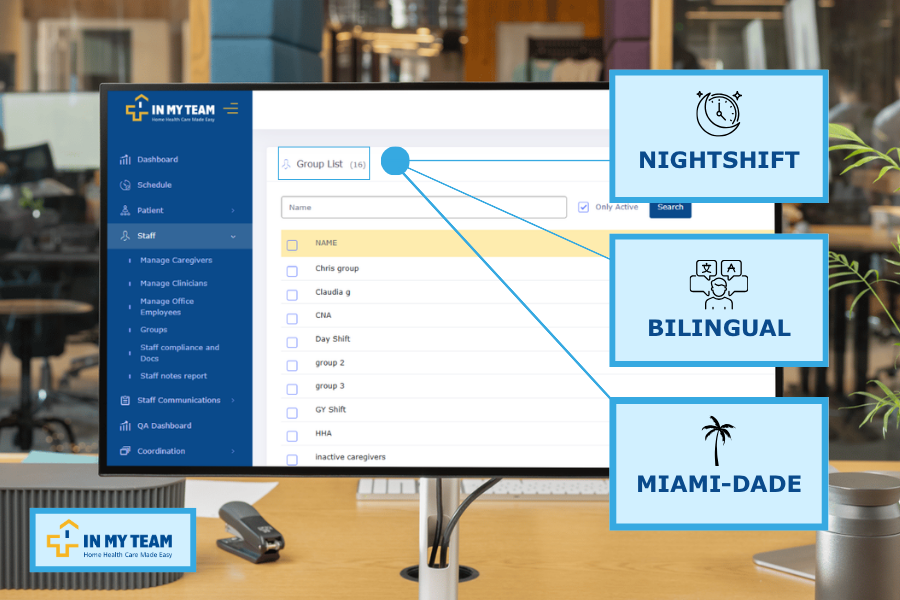
In the context of home care software or an EMR (Electronic Medical Record), groups are customizable categories used to organize staff based on shared characteristics.
Instead of viewing your team as one long list, groups allow you to segment your staff in a way that reflects how your agency actually operates.
Think of groups as dynamic filters that help you instantly answer questions like:
- Who is working tonight?
- Who covers Miami-Dade?
- Who speaks Spanish?
Rather than searching manually, you simply go to the relevant group—and your answer is there.
The Real Problem: Managing Staff One by One
Many agencies still rely on outdated workflows:
- scrolling through long staff lists
- sending messages individually
- trying to remember who fits what criteria
This leads to:
- wasted time
- miscommunication
- delayed scheduling
- increased administrative stress
As your agency grows, this approach becomes unsustainable.
You’re no longer managing a small team—you’re coordinating a complex system.
How Groups Instantly Improve Organization
Groups solve this problem by turning scattered information into structured, actionable data.
Instead of thinking:
“Who can take this case?”
You think:
“Let me check the Bilingual Miami-Dade group.”
That shift alone saves time—but the impact goes much further.
1. Faster Staff Coordination
Need to find the right caregiver quickly?
Groups allow you to filter your staff instantly based on:
- location
- availability
- skillset
No guessing. No digging.
2. Targeted Communication
Instead of sending broad or repetitive messages, you can communicate with specific segments of your team.
For example:
- Notify only the Night Shift team
- Send updates to Broward-based staff
- Reach all bilingual caregivers at once
This reduces noise and ensures the right people get the right information.
3. Smarter Scheduling and Assignments
When your staff is properly grouped, assigning cases becomes more efficient.
You can quickly match:
- patients with language needs → bilingual staff
- location-based cases → local caregivers
- specialized care → trained professionals
This improves both speed and quality of care.
4. Better Visibility Across Your Agency
Groups give you a clearer picture of your workforce.
Instead of fragmented data, you get:
- structured categories
- easy navigation
- real-time clarity
You move from reactive management to proactive organization.
Real-World Examples of Effective Groups
One of the biggest advantages of groups is flexibility.
Every agency operates differently—and your system should reflect that.
Here are some common (and powerful) ways agencies use groups:
By Shift
- Night Shift
- Weekend Team
- On-Call Staff
By Location
- Miami-Dade
- Broward
- Palm Beach
By Skills or Qualifications
- Bilingual
- Alzheimer’s Care
- Pediatric Experience
By Role
- HHAs
- RNs
- LPNs
You’re not limited to predefined categories—you can create groups based on what actually matters to your workflow.
Why This Matters More Than You Think
At first glance, groups might seem like a simple organizational feature.
But in reality, they address a deeper issue:
Operational chaos comes from lack of structure, not lack of effort.
When your team is organized effectively:
- decisions are faster
- communication is clearer
- errors are reduced
- staff feel more supported
And most importantly—you free up time to focus on patient care instead of administrative tasks.
How INMYTEAM Makes Grouping Simple
While the concept of groups is powerful, the real value comes from how easy it is to implement.
With INMYTEAM, groups are designed to be:
- fully customizable
- quick to create and manage
- adaptable to any agency structure
Whether you want to organize by shift, location, language, or something unique to your workflow—you have complete flexibility.
There’s no rigid system forcing you into predefined categories.
You build your groups around how you operate.
Final Thoughts
As your home care agency grows, organization becomes the difference between staying efficient and falling behind.
Groups may seem like a small feature—but they create a big shift:
from scattered information → to structured systems.
And once that structure is in place, everything else becomes easier.