
April 1, 2026 has officially passed, marking the nationwide transition to OASIS-E2—the latest version of the Outcome and Assessment Information Set required by CMS for Medicare-certified home health agencies.
For many agencies, this wasn’t just a deadline—it was the start of a new operational reality.
If your team is still adjusting workflows, retraining clinicians, or identifying compliance gaps, you’re not alone. This guide breaks down what changed, what’s required now, and how to stay compliant—while also working more efficiently.
What Was the OASIS-E2 Deadline?
The OASIS-E2 implementation deadline was April 1, 2026.
According to CMS guidance:
- Any assessment with a completion date (M0090) on or after April 1, 2026 must use OASIS-E2
- Assessments completed before April 1, 2026 remain under OASIS-E1
Source: Centers for Medicare & Medicaid Services (CMS), OASIS-E2 Guidance Manual & Quarterly Q&As
Why OASIS-E2 Matters for Home Health Agencies
OASIS-E2 is more than a routine update—it directly impacts:
- CMS compliance requirements
- Home Health Value-Based Purchasing (HHVBP) performance
- Reimbursement and quality scores
- Survey readiness and audit risk
With CMS continuing to push toward data-driven care and standardized outcomes, accurate OASIS documentation is more critical than ever.
Key Changes in OASIS-E2
While OASIS-E introduced major structural changes, OASIS-E2 focuses on refinement and clarification.
Key updates include:
- Updated item guidance and definitions to reduce ambiguity
- Stronger alignment with HHVBP quality measures
- Increased emphasis on Social Determinants of Health (SDOH)
- Improved consistency in functional and cognitive assessments
These updates are designed to improve data accuracy, comparability, and patient outcomes.
Post-Deadline Challenges Agencies Are Facing
Now that OASIS-E2 is live, agencies are encountering real-world challenges:
1. Transition Errors
Clinicians may still default to OASIS-E1 logic, leading to incorrect responses.
2. Inconsistent Documentation
Variability across clinicians can create data integrity issues and impact outcomes.
3. Increased QA Workload
Quality teams are seeing more corrections, rework, and delays.
4. Productivity Slowdowns
Documentation is taking longer as teams adapt to updated guidance.
What to Do After the OASIS-E2 Deadline
If your agency is now fully operating under OASIS-E2, the focus should shift from transition to optimization.
✔️ Audit Early Assessments
Review assessments completed since April 1 to identify patterns of error and training gaps.
✔️ Provide Targeted Retraining
Focus on high-impact or commonly missed items rather than repeating general training.
✔️ Update Policies & SOPs
Ensure all workflows reflect OASIS-E2 standards—not legacy E1 processes.
✔️ Strengthen QA Processes
Implement stricter pre-submit and pre-bill reviews to reduce downstream issues.
✔️ Monitor CMS Updates
Stay current with CMS clarifications to avoid compliance risks.
How Technology Can Help You Adapt Faster
One of the biggest challenges with OASIS-E2 is balancing accuracy, speed, and clinician workload.
At INMYTEAM Home Care Software, we’re seeing agencies struggle most with documentation consistency during this transition. That’s why leveraging the right technology can make a significant difference.
Introducing AI-Powered OASIS Documentation
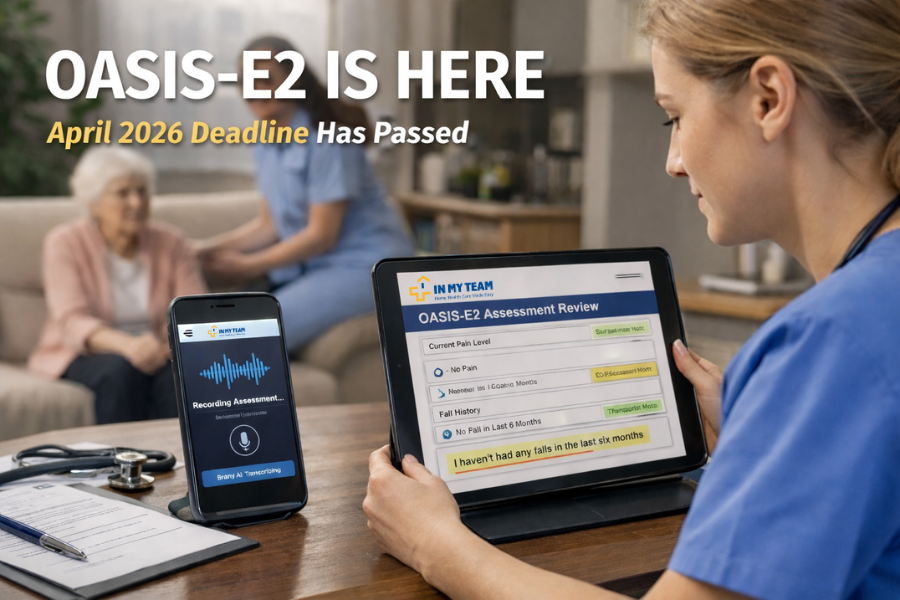
With INMYTEAM’s built-in AI assistant, Brainy, agencies can streamline the entire assessment process:
- Record assessments directly from the mobile app during patient visits
- Brainy listens and transcribes the visit in real time
- In the clinician portal, one click generates a completed OASIS-E2 assessment based on the transcript
Full Transparency & Control
Unlike traditional automation, clinicians stay in control:
- See exactly which part of the transcript was used for each OASIS response
- Easily review and edit answers before submission
- Use the AI OASIS scrubber to catch potential errors and improve accuracy
This approach helps agencies reduce documentation time while maintaining compliance, accuracy, and audit readiness.
Final Thoughts
The April 1, 2026 OASIS-E2 deadline wasn’t the finish line—it was the starting point.
Agencies that succeed in this next phase will:
- Continuously train and support clinicians
- Prioritize documentation accuracy
- Leverage tools that improve efficiency and consistency
- Use OASIS data to drive better outcomes and performance
OASIS-E2 is here—and the agencies that adapt quickly will be the ones that thrive.