
How Home Care Agencies Can Improve Reimbursement With Better Billing and Authorization Visibility
Home care agencies can lose revenue even when services are delivered correctly.
An authorization expires. A client receives services beyond an authorized period. A claim comes back with an error. A payment is only partially received. A pending claim doesn’t get followed up on.
The agency provided the care and paid the caregiver—but reimbursement may still be delayed, reduced, or missed.
For many home care agencies, the underlying problem is lack of visibility.
When authorization, billing, and payment information is difficult to monitor, small issues can go unnoticed until they become revenue problems.
Better visibility helps agencies identify those issues earlier.
What Causes Home Care Agencies to Miss Reimbursement?
Home care reimbursement involves more than submitting a claim.
Before and after a visit, agencies need to monitor several important pieces of information, including:
- Client authorizations
- Authorization dates and service limits
- Completed visits
- Claims submitted
- Billing errors
- Pending claims
- Partial payments
- Completed payments
When these processes aren’t easy to monitor, staff may not realize something requires attention.
For example, an agency could continue scheduling and providing services without realizing that a client’s authorization has expired or is approaching its limit.
The caregiver still needs to be paid.
The agency still incurs the cost of providing care.
But reimbursement for those services may be at risk.
That’s why authorization management and billing visibility are important parts of protecting home care revenue.
Why Is Authorization Tracking Important for Home Care Agencies?
Home care authorizations help determine which services can be provided, for how long, and within what approved limits.
Managing them manually can become difficult as an agency grows.
Imagine monitoring authorization information for dozens—or hundreds—of clients.
Someone on your team needs to know:
Which authorizations are active?
Which are approaching expiration?
Which have already expired?
Which clients may be approaching an authorized service limit?
Without a centralized view, staff may have to check individual records, spreadsheets, or other systems to find the answer.
That increases the chance that something gets overlooked.
How INMYTEAM Helps Agencies Track Authorizations
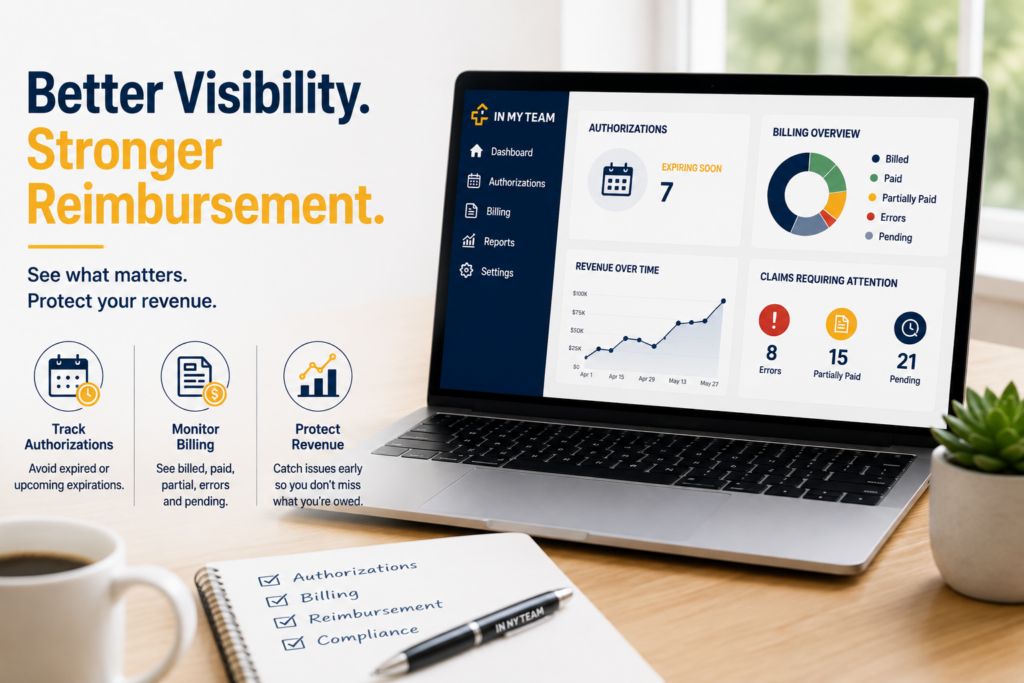
INMYTEAM gives home care agencies an Authorization Dashboard designed to make important authorization information easier to see.
Teams can identify authorizations that are expired or approaching expiration and determine which ones may require attention.
Instead of waiting for someone to discover a problem after services have been delivered, the agency can identify potential authorization issues earlier.
That helps answer an important question before additional care is provided:
Is this service still authorized?
Better authorization visibility can help agencies make more informed scheduling and operational decisions and reduce the risk of providing services outside the applicable authorization.
Billing Visibility Matters After the Visit, Too
Authorization management is only one part of protecting reimbursement.
Once a service has been delivered and billed, agencies need to know what happens next.
A submitted claim isn’t the same as a paid claim.
Home care billing teams need an easy way to answer questions such as:
- Has this service been billed?
- Has the claim been paid?
- Was it only partially paid?
- Did it come back with an error?
- Is payment still pending?
- Does someone need to follow up?
Without clear billing visibility, outstanding revenue can be difficult to identify.
How Can Home Care Software Improve Billing Visibility?
Home care software can centralize billing information so staff can quickly identify claims and payments that require attention.
INMYTEAM’s Billing Dashboard provides visibility into different stages of the billing process, including what’s been:
Billed
Paid
Partially paid
Returned with an error
Still pending
Instead of manually searching for problems, billing teams can use that visibility to identify where follow-up may be needed.
For agency owners and administrators, it also provides a clearer picture of what’s happening between service delivery and reimbursement.
Why Partial Payments and Billing Errors Matter
A claim being marked as processed doesn’t always mean your agency received everything it expected.
Partial payments are a good example.
If your team doesn’t have an easy way to identify partially paid claims, the difference between what was billed and what was received could be overlooked.
Billing errors can create a similar problem.
The longer an error sits unnoticed, the longer potential reimbursement may remain unresolved.
The issue becomes more significant as an agency grows.
One missed payment may be relatively small.
But repeated billing errors, partial payments, authorization issues, and pending claims across hundreds or thousands of visits can add up.
Small reimbursement problems can become significant revenue problems at scale.
Better Visibility Helps Teams Take Action Earlier
A good home care billing system shouldn’t simply store information.
It should help your team understand what needs attention.
That’s an important difference.
Instead of asking:
“Are there any authorization problems?”
Your team should be able to identify them.
Instead of asking:
“Did we get paid for everything?”
Your billing team should be able to see what’s paid, partially paid, pending, or in error.
Instead of discovering problems weeks later, teams can address them earlier in the reimbursement process.
How INMYTEAM Helps Home Care Agencies Protect Revenue
INMYTEAM brings operational and financial information together so home care agencies have greater visibility into the processes that can affect reimbursement.
With INMYTEAM, agencies can:
Track authorizations.
Identify expired and upcoming authorizations that may require attention.
Monitor billing.
See what’s been billed and follow its status.
Identify billing errors.
Find items that may require correction or follow-up.
Monitor payments.
See what’s paid, partially paid, or still pending.
Identify issues earlier.
Give staff a clearer view of what requires attention before small problems become larger ones.
The goal isn’t simply to collect more data.
It’s to make the right information visible at the right time.
What Should a Home Care Billing Dashboard Show?
A useful home care billing dashboard should help staff quickly understand the status of the agency’s billing and identify items requiring attention.
Depending on the agency’s workflows, that can include visibility into:
- Claims that have been billed
- Paid claims
- Partially paid claims
- Claims with errors
- Pending claims
- Items requiring follow-up
Similarly, authorization management tools should make it easy to identify upcoming or expired authorizations so teams can act before providing services that may fall outside the applicable authorization.
Frequently Asked Questions About Home Care Billing and Authorization Management
What is authorization management in home care?
Authorization management is the process of tracking payer or program authorization information associated with a client’s services. Agencies need visibility into authorization periods and other applicable limits so they can determine whether services remain authorized.
What happens when a home care authorization expires?
An expired authorization can create reimbursement risk if services continue to be provided without the necessary authorization. Agencies should review the applicable payer and program requirements and address authorization issues before continuing services when required.
How can home care agencies reduce billing errors?
Agencies can improve their billing processes by maintaining accurate documentation, monitoring claims after submission, identifying errors promptly, and giving billing staff clear visibility into claims requiring action.
Why should agencies monitor partially paid claims?
A partial payment means the amount received may differ from the amount billed or expected. Identifying these claims allows the billing team to investigate the difference and determine whether additional action is appropriate.
How does home care software help with reimbursement?
Home care software can help connect operational, authorization, billing, and payment information. Greater visibility allows staff to identify potential issues earlier instead of relying on manual processes to discover them later.
Better Visibility Can Mean Better Control Over Your Revenue Cycle
Home care agencies work hard to provide quality care.
But delivering the service is only one part of running a financially healthy agency.
You also need visibility into what happens before and after that service is provided.
Is the service authorized?
Was it billed?
Was the claim paid?
Was it only partially paid?
Did an error occur?
Does someone need to take action?
When your team can answer those questions quickly, it becomes easier to identify potential reimbursement issues before they disappear into a spreadsheet, portal, or backlog.
That’s what better visibility is ultimately about:
Seeing what matters. Acting earlier. And helping protect the revenue your agency works hard to earn.
See How INMYTEAM Works
INMYTEAM helps home care agencies manage authorizations, billing, compliance, scheduling, documentation, and more from one connected platform.
See how INMYTEAM can give your team greater visibility into the information that affects your operations and reimbursement.
Complete a personalized demo and receive a $50 gift card for your time.
Want to see what others have to say about us? See our reviews here.