

Finding the Right Caregiver Isn’t Enough: The Next Step in AI-Powered Home Care Scheduling
AI is quickly changing how home care agencies manage scheduling.
Today, several home care software platforms use technology to help schedulers identify caregivers who may be a good fit for an open visit. They can analyze factors like availability, location, skills, client preferences, and compatibility to narrow down a caregiver list.
That’s valuable.
But it still leaves an important question:
Once the software finds the right caregiver, who actually gets the visit filled?
For many scheduling workflows, the answer is still the scheduler.
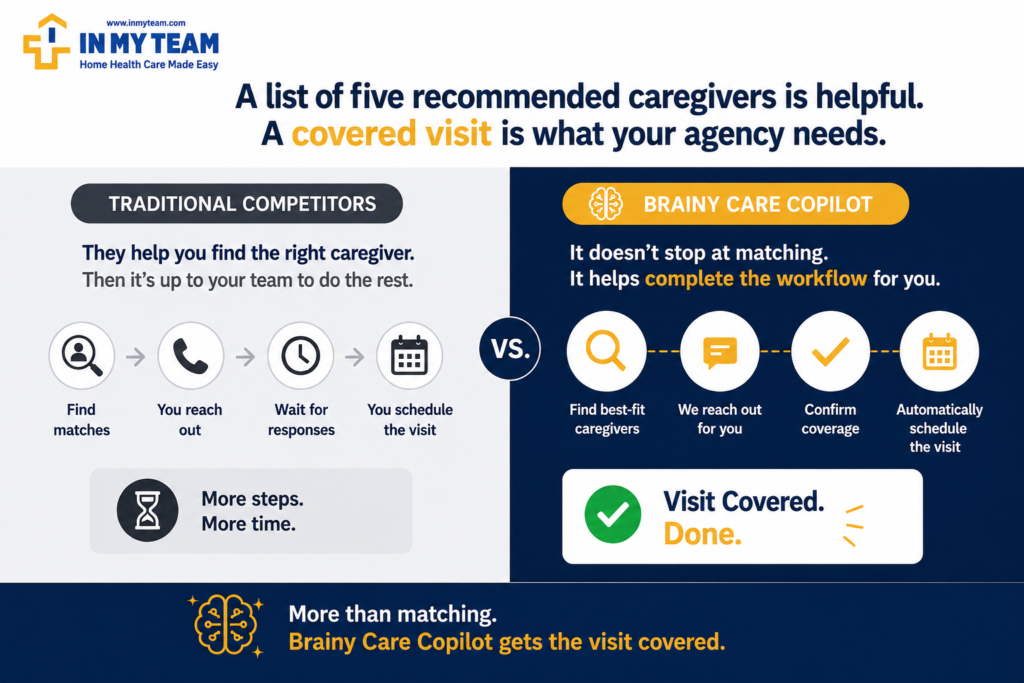
They review the recommendations. They contact caregivers. They wait for responses. They confirm availability. Then they return to the schedule and assign the visit.
INMYTEAM built Brainy Care Copilot to take that workflow further.
AI Matching vs. AI That Actually Takes Action
Traditional caregiver matching technology is designed to make one part of scheduling easier: finding the right person.
Instead of manually searching through dozens or hundreds of caregiver profiles, software can quickly narrow the list based on factors such as:
- Availability
- Location
- Skills and qualifications
- Client requirements
- Caregiver preferences
- Compatibility
That can eliminate a significant amount of searching.
But identifying a match isn’t the same thing as filling a visit.
If the scheduler still has to take the recommendation, contact the caregiver, wait for an answer, and manually finish the assignment, a large part of the administrative work remains.
Brainy Care Copilot was designed around a different question:
What if AI could help complete the workflow instead of simply recommending the next step?
How Brainy Care Copilot Works
Brainy Care Copilot helps INMYTEAM users move from an open visit to a scheduled caregiver with significantly less manual coordination.
The process looks more like this:
Open Visit → Find Best-Fit Caregivers → Reach Out to Caregivers → Confirm Coverage → Schedule the Visit
Brainy Care Copilot evaluates potential caregivers using the information already available within INMYTEAM to identify strong matches.
But it doesn’t stop at presenting a list.
The Copilot can reach out to caregivers on behalf of the agency to help find someone who can take the visit.
Once coverage is confirmed, the visit can then be placed directly onto the patient’s calendar.
That means the scheduler isn’t simply receiving an AI recommendation.
They’re getting help completing the actual scheduling task.
Why This Difference Matters
Consider a common situation.
A caregiver calls out and an agency suddenly needs coverage for an afternoon visit.
A traditional workflow might look something like this:
1. Find caregivers who meet the patient’s requirements.
2. Check who is available.
3. Review distance, skills, preferences, and other factors.
4. Start contacting caregivers.
5. Wait for responses.
6. Contact additional caregivers if the first options decline.
7. Confirm who can take the visit.
8. Return to the schedule.
9. Assign the caregiver to the patient.
AI caregiver matching can make steps 1–3 much faster.
But the scheduler may still own steps 4–9.
Brainy Care Copilot is designed to help with the rest of the workflow too.
That distinction becomes increasingly important as an agency grows.
One open visit may be manageable manually.
Ten open visits, multiple call-outs, hundreds of caregivers, changing availability, and several coordinators trying to keep everything covered is a very different problem.
The Industry Is Moving Beyond Caregiver Recommendations
AI-powered scheduling is becoming increasingly common across home care software.
For example, CareSmartz360’s Smart Scheduler analyzes caregiver information and recommends potential matches for open visits. However, CareSmartz360 states that its Smart Scheduler does not automatically assign caregivers; schedulers review the recommendations and finalize the assignment themselves.
Other platforms are also investing heavily in more advanced scheduling automation, demonstrating where the industry is headed.
The important distinction for agencies evaluating these technologies is therefore no longer simply:
“Does your software use AI for caregiver matching?”
A better question is:
“How much of the scheduling workflow can the technology actually complete for my team?”
Because a list of five recommended caregivers is helpful.
A covered visit is the outcome the agency actually needs.
From Scheduling Assistant to Scheduling Copilot
That’s why we call it a Care Copilot.
The goal isn’t to replace the scheduler or remove agency oversight.
It’s to remove the repetitive work surrounding the decisions schedulers make every day.
Instead of spending their time searching databases, contacting caregiver after caregiver, tracking responses, and manually updating calendars, scheduling teams can spend more time handling exceptions, building caregiver relationships, supporting clients, and managing the situations that actually require human judgment.
AI handles more of the repetitive coordination.
Your team stays in control.
What Could This Mean for a Growing Home Care Agency?
Scheduling is one of those operational challenges that becomes more difficult as an agency becomes more successful.
More clients mean more visits.
More visits mean more caregivers.
More caregivers mean more availability, qualifications, preferences, locations, call-outs, conflicts, and schedule changes to coordinate.
Adding more clients shouldn’t automatically require adding more administrative work at the same rate.
That’s where intelligent automation becomes valuable.
The goal of Brainy Care Copilot isn’t simply to help an agency schedule faster.
It’s to help agencies build a scheduling operation that can scale.
Less caregiver searching
Instead of manually reviewing your roster, Brainy Care Copilot helps identify caregivers who are strong candidates for the visit.
Less back-and-forth
The Copilot can help reach out to caregivers rather than leaving coordinators to work through the list themselves.
Faster coverage
Finding and contacting appropriate caregivers sooner can help agencies respond to open visits and unexpected coverage needs more efficiently.
Less manual scheduling
Once coverage is secured, the caregiver can be scheduled onto the patient’s calendar without requiring the same multi-step workflow from the scheduler.
More time for your team
Schedulers can spend less time acting as the connection between the caregiver database, the phone, and the calendar — and more time managing the agency.
Don’t Just Ask Whether Your Software Has AI
“AI-powered” is quickly becoming a standard phrase across home care technology.
But not every AI feature solves the same amount of work.
When evaluating an AI scheduling solution, agency owners should look beyond whether the platform can recommend caregivers.
Ask:
Can it find the right caregiver?
Can it help contact them?
Can it help secure coverage?
Can it complete the scheduling workflow?
The real value of AI isn’t simply producing another recommendation for your team to act on.
It’s reducing how many repetitive tasks your team has to perform in the first place.
That’s the idea behind Brainy Care Copilot.
Don’t just find your next caregiver. Get the visit covered.
Learn how Brainy Care Copilot and INMYTEAM's built-in AI tools can help your agency spend less time coordinating schedules and more time growing your business.
Want to see what others have to say about us? See our reviews here.