
How AI Is Reducing OASIS Documentation Burden in Home Health

When Documentation Starts to Feel Like the Job
Most home health leaders know the issue isn’t patient care.
It’s documentation.
Nurses don’t leave home health because they dislike caring for patients. They leave because clinical work is increasingly buried under administrative tasks that spill into evenings, weekends, and personal time.
And nowhere is that more evident than with OASIS documentation.
OASIS assessments are essential. They impact reimbursement, quality scores, compliance, and care planning. But they are also one of the most time-consuming and mentally demanding responsibilities placed on clinicians.
The challenge isn’t that nurses don’t understand OASIS.
The challenge is that OASIS was never designed around how nurses actually assess patients.
Assessments happen naturally, through conversation and observation, in the patient’s home.
Documentation often happens later, sometimes hours later, inside rigid, structured forms.
That disconnect is where the burden begins.
The Invisible Weight of OASIS Documentation
OASIS doesn’t just take time. It takes energy.
Nurses carry assessments in their heads long after visits end, trying to remember exact details, clinical wording, and nuances required for accurate and compliant documentation.
Over time, this invisible workload adds up:
Documentation bleeding into personal time
Increased mental fatigue and burnout
Less focus and energy during patient visits
A growing sense that their time isn’t respected
Many nurses don’t openly complain. They adapt. They stay late. They get it done.
But adaptation shouldn’t be mistaken for satisfaction.
Why Familiar Systems Keep the Burden in Place
Agencies often hesitate to change documentation workflows because nurses are already “comfortable” with their systems.
But familiarity usually means nurses have learned how to work around inefficiencies.
They memorize where to click.
They keep side notes.
They create personal systems just to survive documentation demands.
That doesn’t mean the system is working. It means nurses are compensating for it.
When OASIS documentation lives entirely inside complex forms instead of flowing from the clinical visit itself, the burden falls squarely on clinicians.
Reducing Burden Starts With Removing the Disconnect
The goal of better technology isn’t to make nurses document faster.
It’s to remove unnecessary steps altogether.
The biggest opportunity in OASIS documentation is eliminating the gap between assessment and documentation, capturing clinical insight while it’s fresh, accurate, and natural.
That’s where AI is changing the workflow.
How AI-Powered OASIS Transcription Works
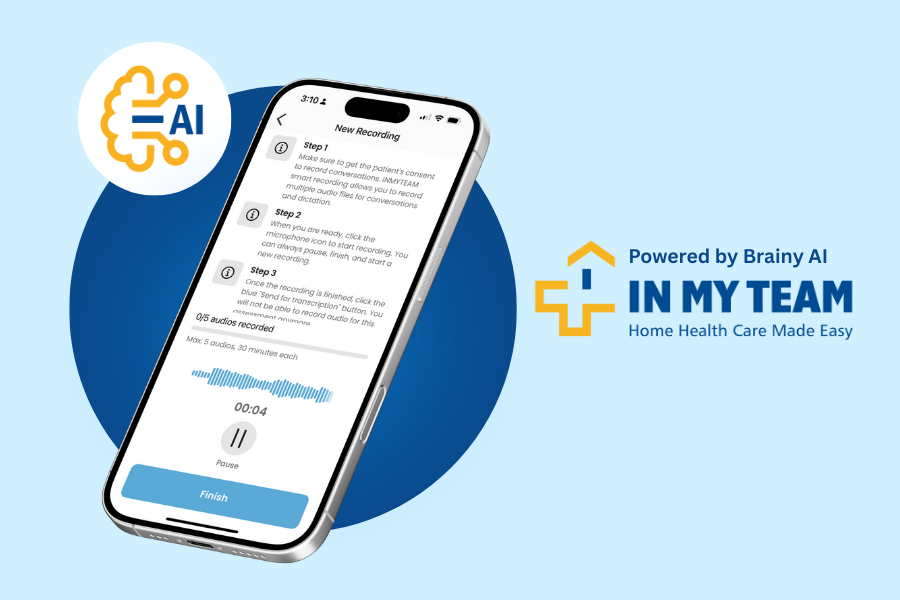
INMYTEAM’s AI-powered OASIS transcription is designed to support clinicians, not replace them.
Here’s how it works:
Nurses record their OASIS assessment conversation during or after the visit
AI securely transcribes the audio
Clinical responses are intelligently mapped into structured OASIS fields
Nurses review, validate, and finalize the documentation
This isn’t generic transcription. It’s built specifically for home health and OASIS logic.
The result is documentation that is:
Faster to complete
Easier to review
More consistent and compliant
Less mentally exhausting
Most importantly, documentation stays closer to the moment of care, where accuracy is highest and stress is lowest.
What This Means for Nurses and Agencies
For nurses, AI-assisted OASIS documentation means:
Less after-hours documentation
Reduced cognitive load
More time and energy for patient care
Workflows that respect how they actually practice
For agencies, it means:
Improved documentation efficiency
More consistent OASIS data
Reduced burnout and turnover risk
Better visibility without increasing pressure on staff
This isn’t about forcing change. It’s about giving nurses relief, and letting better workflows speak for themselves.
The Future of OASIS Documentation
Nurses aren’t afraid of technology.
They’re afraid of more work.
When technology removes friction instead of adding it, adoption happens naturally.
AI-powered OASIS transcription isn’t about doing more.
It’s about finally doing less, without sacrificing quality or compliance.
Home health agencies that succeed moving forward will be the ones that stop asking nurses to carry the documentation burden alone.
Better tools don’t change the work nurses love.
They protect it.
Interested in exploring how INMYTEAM can reduce workload, simplify documentation, and support clinical teams in the field? Fill out the form below!
Want to see what others have to say about us? See our reviews here.