

How to Spot EVV Visit Tracking Gaps in 7 Steps (2026)
Missed clock-ins, undocumented visits, and manual overrides that slip past review create electronic visit verification gaps your agency may not notice until an audit flags them. These breakdowns in caregiver visit tracking put Medicaid reimbursements, payer relationships, and your agency’s operational stability at risk.
Most EVV compliance gaps follow predictable patterns. Once you know where to look, you can catch documentation and time-tracking issues before they escalate. INMYTEAM helps home care agencies identify and close these verification breakdowns with built-in compliance monitoring tools.
This guide walks you through seven steps to find and fix the visit tracking gaps that lead to EVV compliance problems.
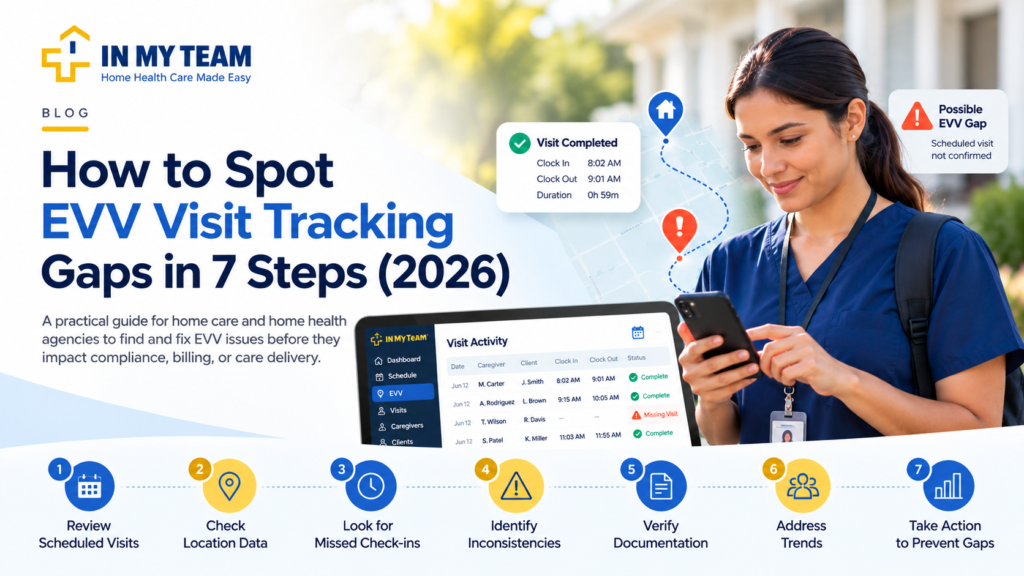
Quick Guide: How to Spot EVV Tracking Gaps in 7 Easy Steps
- Audit Your Current Clock-In and Clock-Out Records: Pull your EVV data for the past 30 days and check for missing, incomplete, or late entries across all caregivers.
- Identify Manual Override Patterns: Flag every supervisor-edited visit record and look for clusters that suggest a process failure rather than a one-time correction.
- Compare Scheduled Visits Against Verified Visits: Match your scheduling data to EVV records and quantify the gap between planned and confirmed visits.
- Check GPS and Location Verification Accuracy: Review location data for visits that registered outside the expected service area or lacked a GPS reading entirely.
- Review Caregiver Documentation Completion Rates: Measure how often visit notes, task lists, and required forms are submitted on time and in full.
- Evaluate Your Exception Handling Workflow: Map the process your team follows when an EVV exception occurs, from alert to resolution, and measure average response time.
- Build a Recurring Compliance Review Cycle: Set a weekly or biweekly cadence for reviewing EVV data so gaps are caught before they compound into audit findings.
How to Identify Caregiver Visit Tracking Gaps That Create EVV Compliance Risk
- Audit Your Current Clock-In and Clock-Out Records
Start by pulling a full export of your EVV clock-in and clock-out data for the past 30 days. Look for visits that are missing a start time, an end time, or both. Also flag entries where the caregiver clocked in but never clocked out, or where the recorded visit duration does not match the authorized service hours.
Pay attention to patterns. If the same caregiver consistently has incomplete records, the issue may be a training gap or a technology barrier, such as poor cell signal in a rural service area. If incomplete records are spread across your staff, you may have a systemic process problem.
Tip: Run this audit by payer and service type. Medicaid-funded personal care visits carry stricter documentation requirements under the 21st Century Cures Act than some private-pay services, so prioritize those records first.
- Identify Manual Override Patterns
Every EVV system allows supervisors to manually adjust visit records when legitimate corrections are needed. A caregiver forgot to clock out, a GPS error registered the wrong address, or a visit ran past the scheduled window. These edits are normal in small numbers.
The compliance risk appears when manual overrides become routine. According to a 2026 HHS Office of Inspector General audit of Colorado’s EVV system, the state did not verify that all personal care service visits were recorded and verified in its EVV system. The audit identified millions of dollars in estimated overpayments tied to claims that lacked compliant verification.
Set a threshold for your agency. If more than 10 to 15 percent of visits in a given week require manual adjustment, treat that as a signal to investigate rather than a normal correction rate.
- Compare Scheduled Visits Against Verified Visits
Your scheduling system and your EVV records should tell the same story. When they do not, the difference is your verification gap: the number of visits that were planned and authorized but never confirmed through electronic verification.
Export your schedule for a given period and cross-reference it with your verified EVV data. Count the visits that appear on the schedule but have no corresponding EVV record. Then categorize them: was the visit canceled, rescheduled, or simply never verified?
A high number of unverified visits that were not formally canceled suggests caregivers are completing visits but failing to use the EVV system. That is a training and workflow problem, not a care delivery problem, and it is fixable.
- Check GPS and Location Verification Accuracy
Location is one of the six data elements the 21st Century Cures Act requires EVV systems to capture. If your caregivers’ location data frequently shows them outside the patient’s service area, or if GPS readings are absent entirely, your records may not withstand audit scrutiny.
Common causes of location data issues include caregivers with older devices that have unreliable GPS, visits in areas with weak cellular coverage, and caregivers who deny location permissions on their phones. INMYTEAM’s Caregiver App captures real-time GPS data at clock-in and clock-out, giving your agency accurate location verification for every visit.
For agencies operating in rural areas, consider whether your EVV solution offers a telephony option. INMYTEAM provides a customized Telephony line as an alternative for caregivers without reliable smartphone access, ensuring visit verification is captured regardless of device limitations.
- Review Caregiver Documentation Completion Rates
EVV clock-ins confirm presence. Visit documentation confirms the work. When one exists without the other, you have a gap that auditors will notice.
Pull a report showing the percentage of visits where the caregiver completed all required documentation, including visit notes, task checklists, and care plan updates, within the required timeframe. Focus on visits where the EVV check-in was recorded but the supporting notes were submitted late or not at all.
Late documentation is a common contributor to compliance risk because retroactive entries can be flagged during audits. Your documentation tools should make it simple for caregivers to submit notes during or immediately after a visit, reducing the lag between service delivery and record completion.
- Evaluate Your Exception Handling Workflow
When an EVV exception occurs, such as a missed clock-in, a location mismatch, or a visit that exceeded the authorized duration, how quickly does your team respond? Agencies that lack a defined exception-handling workflow often let flagged visits sit unresolved for days or weeks.
Map the current process from the moment an alert fires to the moment it is resolved. Identify where delays occur. Is a coordinator responsible for reviewing exceptions daily, or does the task fall through the cracks until billing?
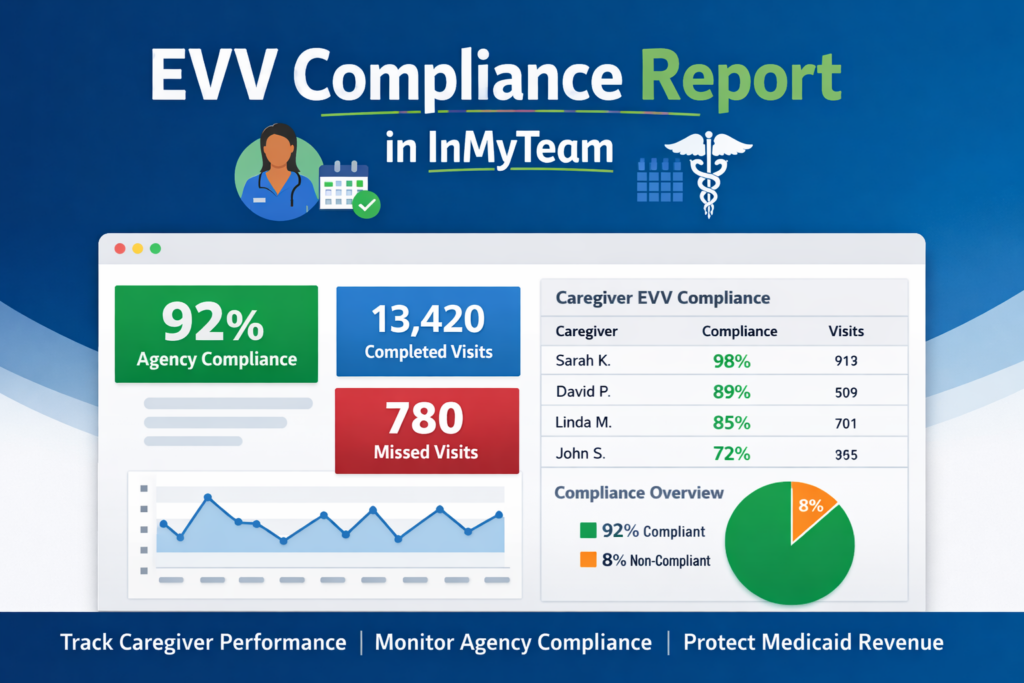
INMYTEAM provides a live EVV Percentage report that shows your agency’s compliance standing in real time. This gives coordinators a clear picture of which visits need attention, so exceptions get addressed before they affect claims.
- Build a Recurring Compliance Review Cycle
A one-time audit finds problems. A recurring review cycle prevents them. Set a weekly or biweekly cadence where a designated team member reviews EVV data against the six checkpoints above.
During each review, document the number of unverified visits, the manual override rate, documentation completion percentages, and any location data anomalies. Track these metrics over time to identify whether your corrective actions are working.
Agencies that maintain above a 90% EVV compliance rate position themselves for smoother audits, fewer claim denials, and stronger payer relationships. Consistent monitoring is how you get there and stay there.
What Happens When EVV Visit Tracking Gaps Go Undetected?
Undetected EVV gaps create a compounding risk for your agency. Each unverified visit represents a claim that could be denied during a payer review or flagged in a state audit. Over time, those individual gaps accumulate into a pattern that draws regulatory attention.
The consequences are specific and documented. Agencies with sustained EVV compliance failures face claim denials and payment delays, increased audit frequency, strained relationships with managed care organizations, and potential Medicaid disqualification in severe cases.
Federal oversight is intensifying. The HHS Office of Inspector General has an active audit series examining EVV implementation across multiple states. Completed reports have already identified millions of dollars in non-compliant Medicaid claims.
Your agency does not need to be the subject of an investigation to feel the impact. Payer-level compliance thresholds are tightening, and agencies that fall below those benchmarks face real revenue consequences.
How Can Your Agency Prevent EVV Gaps Before They Start?
Prevention starts with choosing the right combination of training, workflow design, and technology. No single tool eliminates every gap, but agencies that build verification into their daily operations rather than treating it as a billing afterthought reduce their exposure significantly.
Invest in onboarding that teaches caregivers not just how to clock in and out, but why accurate EVV matters to the agency and to their own employment stability. Reinforce this training during regular staff check-ins. Most EVV failures are not intentional; they stem from unclear expectations and inconsistent follow-through.
On the technology side, your EVV solution should integrate directly with your scheduling, billing, and documentation systems. When these tools operate as separate platforms, data falls through the gaps between them. A unified system, where a scheduled visit automatically creates an expected EVV entry and flags any discrepancy, closes the most common verification breakdowns before they reach your billing team.
How Can Your Agency Prevent EVV Gaps Before They Start?
Prevention starts with choosing the right combination of training, workflow design, and technology. No single tool eliminates every gap, but agencies that build verification into their daily operations rather than treating it as a billing afterthought reduce their exposure significantly.
Invest in onboarding that teaches caregivers not just how to clock in and out, but why accurate EVV matters to the agency and to their own employment stability. Reinforce this training during regular staff check-ins. Most EVV failures are not intentional; they stem from unclear expectations and inconsistent follow-through.
On the technology side, your EVV solution should integrate directly with your scheduling, billing, and documentation systems. When these tools operate as separate platforms, data falls through the gaps between them. A unified system, where a scheduled visit automatically creates an expected EVV entry and flags any discrepancy, closes the most common verification breakdowns before they reach your billing team.
FAQs About EVV Visit Tracking Gaps
What is an EVV visit tracking gap?
An EVV visit tracking gap is any instance where a scheduled or delivered home care visit lacks a complete Electronic Visit Verification (EVV) record. This includes missing clock-ins, absent location data, or incomplete documentation. INMYTEAM flags these gaps automatically so your team can resolve them before they affect claims.
Why do caregivers miss EVV clock-ins?
Common reasons include poor cell signal in rural areas, older devices with unreliable GPS, unclear training on when and how to use the app, and rushing between back-to-back visits. Addressing these gaps typically requires a combination of better onboarding, device support, and a telephony backup option.
How often should my agency review EVV compliance data?
Weekly reviews are the minimum recommended cadence for agencies managing Medicaid-funded visits. A biweekly cycle may work for smaller agencies with fewer caregivers. INMYTEAM’s live EVV Percentage report makes this review straightforward by surfacing unverified visits and compliance trends in real time.
What does the 21st Century Cures Act require for EVV?
The 21st Century Cures Act requires states to implement EVV systems that capture six data points for Medicaid-funded home care visits: service type, the individual receiving care, the date, service location, the caregiver providing the service, and the start and end times. Non-compliant states face reductions in federal Medicaid matching funds.
Can EVV gaps lead to Medicaid disqualification?
Sustained EVV non-compliance can result in claim denials, increased audits, payment delays, and in severe cases, potential Medicaid disqualification for your agency. INMYTEAM helps you maintain above a 90% compliance rate through real-time monitoring and automated alerts, reducing your exposure to these consequences.
